How to Use Instagram Ads Manager Like a Pro
Instagram has evolved from a photo-sharing app into a global marketplace, and for businesses, mastering its advertising platform is no longer optional—it's essential for growth. Instagram Ads Manager, integrated within the Meta Ads Manager, is a powerful and complex tool that allows you to create, manage, and optimize campaigns with precision. But to use it "like a pro," you need more than just a budget; you need a strategy.
This comprehensive guide will walk you through the entire process of using Instagram Ads Manager to its full potential. We'll cover everything from setting clear objectives and targeting the right audience to crafting compelling ads and analyzing your results for maximum return on investment (ROI).
Table of Contents
- Why Use Instagram Ads Manager?
- The Foundation: Setting Clear Campaign Objectives
- Step 1: Defining Your Target Audience
- Step 2: Choosing Your Ad Placements
- Step 3: Setting Your Budget and Schedule
- Step 4: Crafting Compelling Ad Creatives and Copy
- Step 5: The Power of Retargeting
- Step 6: Managing DMs from Your Ad Campaigns
- Step 7: Measuring Success and Optimizing Your Ads
- Conclusion: From Ad Spend to Investment
Why Use Instagram Ads Manager?
While the "Boost Post" button on your Instagram profile offers a quick and easy way to promote content, it barely scratches the surface of what's possible. The full Instagram Ads Manager (within Meta Ads Manager) provides a suite of advanced tools that give you granular control over your campaigns, including:
- Advanced Targeting: Go beyond basic demographics to target users based on their interests, behaviors, and previous interactions with your brand.
- Specific Objectives: Optimize your campaign for specific goals like conversions, lead generation, or website traffic.
- Creative Control: A/B test different ad creatives, copy, and placements to see what resonates best with your audience.
- In-Depth Analytics: Get detailed insights into your campaign's performance to measure ROI and make data-driven decisions.
The Foundation: Setting Clear Campaign Objectives
Every successful ad campaign starts with a clear goal. In Ads Manager, your objective tells Instagram what you want to achieve, and the algorithm optimizes your ad delivery accordingly. The main objectives fall into three categories:
- Awareness: To introduce your brand to a new audience (e.g., Brand Awareness, Reach).
- Consideration: To get people to think about your business and seek more information (e.g., Traffic, Engagement, Video Views, Lead Generation, Messages).
- Conversion: To encourage people to take a specific action (e.g., Purchases, Catalog Sales, Store Traffic).
Choosing the right objective is the most critical first step. If your goal is to sell a product, choosing "Traffic" instead of "Conversions" will lead to suboptimal results.
Step 1: Defining Your Target Audience
Your ad is only as good as the audience it reaches. Ads Manager allows you to create highly specific audiences.
- Core Audiences: Target users based on location, demographics (age, gender), interests (e.g., pages they like, topics they follow), and behaviors (e.g., online purchasing behavior).
- Custom Audiences: This is where the real power lies. You can create audiences based on people who have already interacted with your business. This includes:
- Your website visitors (requires the Meta Pixel).
- People who have engaged with your Instagram or Facebook page.
- Your existing customer list.
- Lookalike Audiences: Once you have a high-quality Custom Audience, you can ask Instagram to create a "Lookalike Audience"—a new group of people who share similar characteristics with your best customers. This is a powerful tool for finding new, relevant customers.
Step 2: Choosing Your Ad Placements
Ads Manager allows you to choose exactly where your ads will appear. While "Advantage+ Placements" (formerly Automatic Placements) is the default and recommended option, you can also manually select placements. For Instagram, this includes:
- Feed: The standard in-feed placement.
- Stories: Full-screen, immersive vertical ads.
- Reels: Short-form video ads that appear between Reels.
- Explore: Reach users when they are in a discovery mindset.
Start with automatic placements and then use the "Breakdown" feature in your analytics to see which placements are performing best.
Step 3: Setting Your Budget and Schedule
- Budget: You can set a daily budget for continuous delivery or a lifetime budget for a specific campaign duration.
- Schedule: Choose to run your ads continuously or set a start and end date. You can also use "ad scheduling" to run your ads only on specific days or at certain times (e.g., when your audience is most active).
Step 4: Crafting Compelling Ad Creatives and Copy
Your ad creative needs to stop the scroll.
- Use High-Quality Visuals: Use clear, high-resolution images and videos.
- Design for Mobile-First: Most users will see your ad on a mobile device. Use vertical formats for Stories and Reels and ensure any text is readable on a small screen.
- Write Ad Copy That Converts:
- Strong Hook: Grab attention with your first sentence.
- Focus on Benefits: Explain how your product or service solves a problem.
- Clear Call-to-Action (CTA): Tell users exactly what to do next (e.g., "Shop Now," "Learn More," "Sign Up").
Step 5: The Power of Retargeting
Retargeting is the practice of showing ads to people who have already interacted with your brand but haven't yet converted. This is one of the most effective strategies for driving sales. Use Custom Audiences to retarget:
- Website visitors who viewed a product but didn't purchase.
- Users who added an item to their cart but abandoned it.
- People who have engaged with your past Instagram posts.
These "warm" audiences are much more likely to convert than a cold audience seeing your brand for the first time.
Step 6: Managing DMs from Your Ad Campaigns
Many high-performing Instagram ad campaigns, especially those with a "Send Message" CTA, will drive a significant number of Direct Messages. How you manage this influx of inquiries is crucial for converting leads into customers. A prompt, professional, and personalized response can make all the difference.
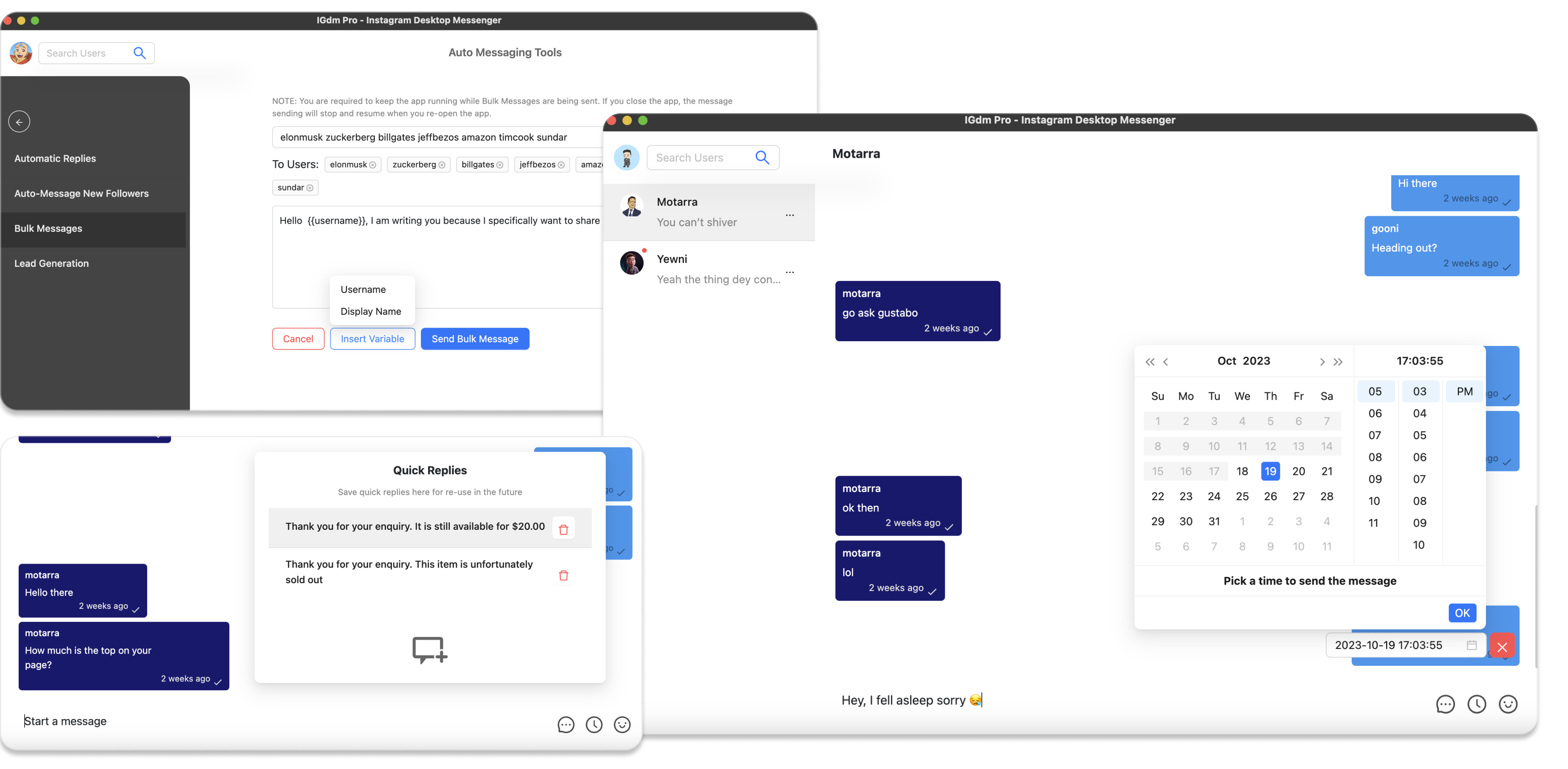
This is where a powerful desktop DM management tool like IGdm Pro becomes an essential part of your campaign workflow. It helps you manage the conversations your ads generate with efficiency and scale.
With IGdm Pro, you can:
- Set Up Auto-Replies: Instantly answer common questions triggered by your ads. For example, if your ad prompts users to DM you for "more info," an Automatic Reply can deliver that information immediately, qualifying the lead while their interest is at its peak.
- Organize and Prioritize Leads: Use Labeled Conversations to categorize incoming DMs (e.g.,
Ad Lead - Campaign A,Urgent Inquiry). This keeps your inbox organized and allows your team to prioritize follow-ups. - Streamline Follow-Ups: Use Quick Replies to save templates for common responses and Message Reminders to ensure no promising lead is ever forgotten.
By integrating a tool like IGdm Pro into your post-campaign workflow, you can efficiently nurture the leads your ads generate, significantly boosting your overall ROI.
Step 7: Measuring Success and Optimizing Your Ads
Don't set your campaign and forget it. Continuous monitoring and optimization are key to success.
- Track Your KPIs: In Ads Manager, keep a close eye on your key metrics, such as Cost Per Click (CPC), Click-Through Rate (CTR), Conversion Rate, and Return on Ad Spend (ROAS).
- A/B Test Everything: Test different audiences, creatives, copy, and placements to find your winning combination.
- Scale What Works: Once you have a clear winner, turn off underperforming ads and allocate more budget to the successful ones.
Conclusion: From Ad Spend to Investment
Using Instagram Ads Manager like a pro is about moving from simply "boosting posts" to building a strategic, data-driven advertising machine. By setting clear objectives, mastering audience targeting, creating compelling ads, and continuously optimizing your campaigns, you can turn your ad spend into a powerful investment that drives real, measurable growth for your business.
And as your ads bring in a new wave of interested customers, remember that a streamlined and professional DM management process is the final, crucial step in converting that interest into revenue. With the right strategy and tools, you can build a high-performing Instagram advertising funnel that delivers results, time and time again.